

There’s a moment I keep replaying from CES 2026. I’m watching a LEGO brick — just a regular 2x4 brick — respond to how a child is playing with it. No screens. No app to download. The brick itself senses motion, recognizes which Star Wars character is nearby, and plays the Imperial March when Emperor Palpatine sits on his throne. It’s a computer smaller than your thumbnail, embedded in plastic that costs $70.
That’s when it hit me: we’re watching the boundary between physical and digital objects completely dissolve.
The Invisible Computing Revolution
CES has always been about what’s next in consumer technology. But this year felt different. After two years dominated by ChatGPT demonstrations and generative AI parlor tricks, 2026’s show floor told a more grounded story: AI is finally leaving the screen.
The show was dominated by “physical AI” and robotics, from humanoid robots working factory floors to AI-powered devices that most people wouldn’t recognize as “smart” at all. Boston Dynamics unveiled its production-ready electric Atlas robot with a confident stride and 56 degrees of freedom. Nvidia CEO Jensen Huang brought a cowboy-hat-wearing humanoid on stage. AMD showcased its GENE.01 humanoid powered by its latest processors.
But here’s what matters for product designers: the breakthrough isn’t that robots can now walk or that chips are more powerful. It’s that intelligence is becoming ambient — woven into objects we already use, invisible until the moment we need it.
Design Lesson #1: The Interface Is the Object
LEGO’s Smart Play platform represents something more profound than a toy upgrade. It’s a masterclass in what happens when you completely rethink the relationship between physical form and digital capability.
The Smart Brick contains a 4.1mm ASIC chip — smaller than a standard LEGO stud — running something called the Play Engine that can sense motion, orientation, and magnetic fields. Through integrated copper coils, each brick knows its distance, direction, and orientation relative to other Smart Bricks. There’s a tiny speaker, an accelerometer, and an LED array — all in a form factor that snaps together with 70 years of existing LEGO pieces.
What LEGO understood that most tech companies miss: the object itself should be the interface. Using a proprietary wireless system called BrickNet based on Bluetooth, the bricks communicate directly without apps, internet connections, or external controls. You open the box and start building, exactly like traditional LEGO. The “smart” part amplifies play rather than replacing it.
This is the future of human-AI collaboration: not more screens demanding our attention, but intelligence that responds to how we naturally interact with physical objects.
The Folding Problem (And What It Teaches Us)
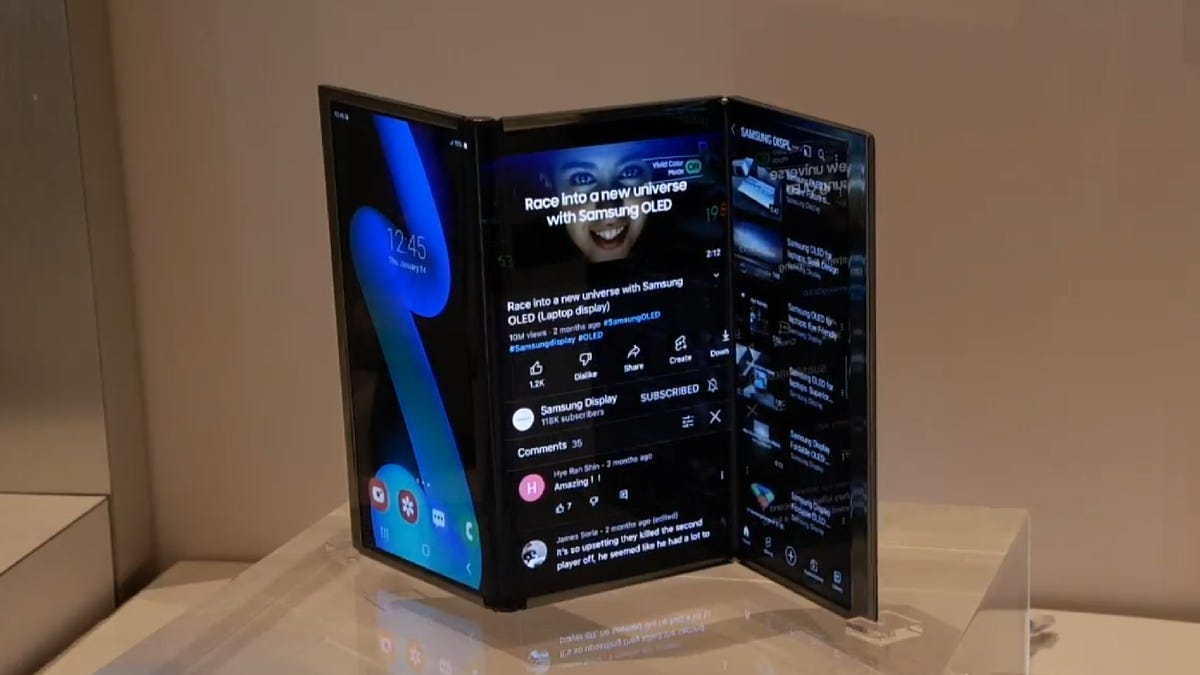
Samsung’s Galaxy Z TriFold tells a different story — one about the compromises inherent in pushing boundaries.
The device unfolds twice to reveal 10 inches of AMOLED display, essentially transforming a phone into a legitimate tablet. When fully extended, it’s a mere 3.9mm at its thinnest point — an engineering marvel. But folded up? It’s 12.9mm thick and weighs 10.9 ounces, bringing us back to the bulk of foldables from several generations ago.
I spoke with several people who handled it at CES. The consensus: when you open it up, all concerns evaporate. The screen is transformative. With Samsung DeX desktop mode, you basically get a miniature laptop experience from a device that fits in a pocket. The 4:3 aspect ratio makes widescreen content actually usable. It’s genuinely impressive.
But it’s also $2,500. And it violates a core principle we’ve learned over the past decade: form factor matters more than features.
Here’s the lesson: breakthrough capability doesn’t guarantee breakthrough adoption. The TriFold is technically remarkable, but it asks users to accept significant physical trade-offs for digital gains. Compare this to LEGO’s approach — where digital capability enhances rather than compromises the core physical experience — and you see two very different philosophies.
The Robot in the Room
The other impossible-to-ignore trend was the sheer number of humanoid robots.
McKinsey estimates the market for general-purpose robotics could reach $370 billion by 2040, with warehouse logistics, manufacturing, retail, agriculture, and healthcare as top use cases. But walking the show floor, you realize we’re past the “will robots work?” question and deep into “which robots for which contexts?”
Boston Dynamics’ Atlas will begin working in Hyundai factories by 2028. LEM Surgical showcased a three-armed surgical robot (described as a “humanoid” despite lacking legs) already holding FDA clearance. EngineAI’s T800 humanoid, starting at $25,000, ships mid-2026.
What’s striking isn’t the robots themselves — it’s how specialized they’re becoming. We’re not building general-purpose androids. We’re creating purpose-built physical AI for specific workflows. This mirrors exactly what we’ve seen in software: the most successful AI implementations solve discrete, well-defined problems rather than trying to do everything.
What This Means for Product Designers
So what should we take from CES 2026? Three actionable insights:
1. Rethink the role of screens. The assumption that every smart product needs a display is dying. LEGO proved you can create rich, responsive experiences through sound, light, and tactile feedback alone. Ask yourself: does your product need a screen, or have we just defaulted to screens because that’s what we know?
2. Prioritize the physical experience. Samsung’s TriFold is a cautionary tale about letting digital ambition compromise physical usability. Your product lives in users’ hands, bags, and daily routines. Hardware compromises required to achieve breakthrough features can be difficult to ignore. Design for the 90% of time when the “smart” features aren’t active.
3. Intelligence should amplify, not replace. The most compelling products at CES didn’t replace human capability — they extended it. Robots that help workers lift heavier loads. Bricks that respond to children’s imagination. Surgical systems that give doctors sub-millimeter precision. The pattern is clear: AI succeeds when it acts as a capable assistant, not a replacement.
The Tangible Future
Here’s what keeps me up at night: we’re entering an era where the distinction between “physical product” and “digital product” becomes meaningless.
A LEGO brick is now also a computer. A surgical tool is also an AI system. A phone is also a tablet is also a laptop. The products that succeed in the next five years will be those that thoughtfully blend physical and digital in ways that feel invisible — until they’re indispensable.
CES 2026 wasn’t about any single breakthrough product. It was about a fundamental shift in how we think about the relationship between objects and intelligence. The smartest products aren’t trying to replace physical experiences with digital ones. They’re making physical objects smarter, more responsive, more aligned with how humans naturally interact with the world.
The question for every product designer isn’t “should we add AI?” anymore. It’s “how do we embed intelligence so seamlessly that users forget it’s there?”
That’s the bar CES 2026 set. And that’s the challenge ahead.
References
Engadget. “Lego unveils a technology-packed Smart Brick at CES 2026.” January 2026. https://www.engadget.com/entertainment/lego-unveils-a-technology-packed-smart-brick-at-ces-2026-190000511.html
LEGO Group. “LEGO SMART Play Announcement — CES.” January 5, 2026. https://www.lego.com/en-us/aboutus/news/2026/december/lego-smart-play-announcement
Yahoo Finance. “AI, chips, and robots dominated CES 2026. It’s just the beginning.” January 2026. https://finance.yahoo.com/news/ai-chips-and-robots-dominated-ces-2026-its-just-the-beginning-192942893.html
CNBC. “Humanoid robots take over CES in Las Vegas as tech industry touts future of AI.” January 2026. https://www.cnbc.com/2026/01/09/humanoid-robots-take-over-las-vegas-at-ces-tech-touts-future-of-ai.html
Interesting Engineering. “9 humanoid robots at CES 2026 that showed the future is already here.” January 2026. https://interestingengineering.com/ai-robotics/9-humanoid-robots-at-ces-2026
Engadget. “Samsung Galaxy Z TriFold hands-on: Flexing is believing at CES 2026.” January 2026. https://www.engadget.com/mobile/smartphones/samsung-galaxy-z-trifold-hands-on-flexing-is-believing-at-ces-2026-224343480.html
Android Authority. “Samsung Galaxy Z TriFold hands-on at CES 2026: The future is here?” January 2026. https://www.androidauthority.com/samsung-galaxy-z-trifold-hands-on-ces-2026-3629578/
Arm Newsroom. “Top 5 trends you can expect from CES 2026 in Las Vegas.” December 2025. https://newsroom.arm.com/blog/top-trends-for-ces-2026
TechRadar. “Forget AI — these will be the 11 biggest gadget trends of 2026, according to CES 2026.” January 2026. https://www.techradar.com/tech/the-11-biggest-tech-trends-of-2026-according-to-ces-2026
CES.tech. “Roboticists at CES 2026: A Sample Itinerary.” 2026. https://www.ces.tech/articles/roboticists-at-ces-2026-a-sample-itinerary/