

Imagine being handed the most powerful cognitive tool in human history, and your first instinct is to use it as a typewriter.
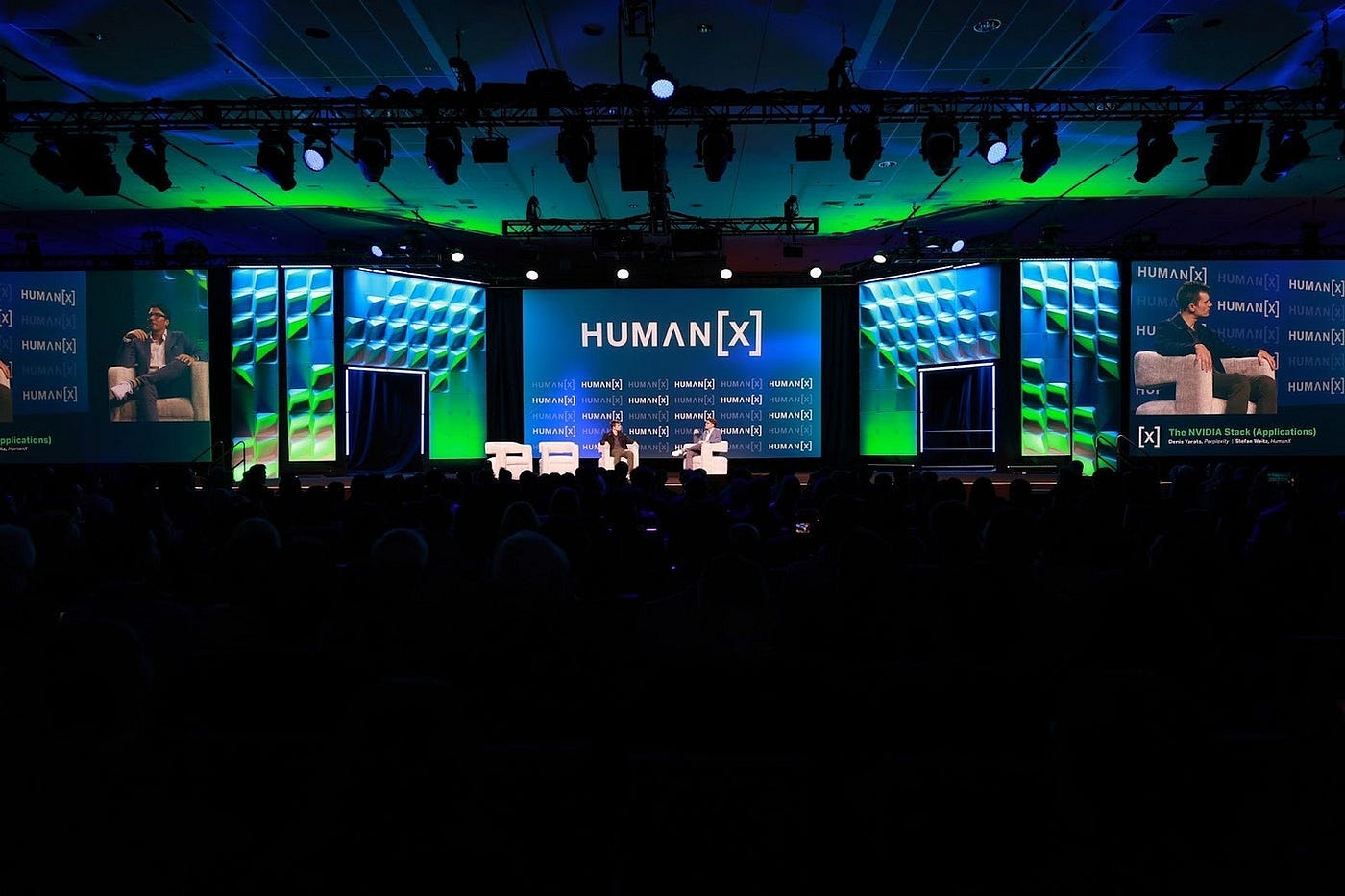
That’s not a hypothetical. That’s what Ali Ghodsi, co-founder and CEO of Databricks, described at HumanX 2026 — and it’s the uncomfortable mirror that the entire conference held up to anyone building AI products today.
“The AIs have already achieved AGI, maybe a year or two ago,” Ghodsi said plainly. “The models are plenty smart. The problem is they don’t have the context. And that’s going to take a really long time to fix. It’s not something the next model release is going to solve.”
I sat with that for a while. And then I watched the rest of the conference double down on it, from nearly every angle.
The Gap No One Wants to Talk About
There’s a collective fantasy running through the AI industry right now: that the next model release will close the distance between what AI can do and what it’s actually doing inside enterprises and products. A better model, the thinking goes, fixes everything.
Ghodsi thinks that’s misdirected. So does Bret Taylor, CEO of Sierra and chairman of OpenAI. So does Matt Garman, CEO of AWS, who quietly mentioned that Amazon’s internal developers are seeing 4.5x productivity gains from AI — and yet, most of the world is still manually filing reports, sitting through status update meetings, and copy-pasting between systems.
The gap isn’t capability. It’s context. It’s organizational process. It’s the willingness — and the design intelligence — to actually restructure how work gets done.
Taylor put it bluntly: “The Venn diagram of people who know how to make an agent and understand accounting rules is the empty set. Everyone who knows how to make websites using the previous generation of technology just wants to make website-making tools.”
We’re building with the medium we know, not the one that’s possible.
The Bottleneck Has Moved — Have You?
Here’s what struck me most across ten talks at HumanX: the bottleneck in product development has fundamentally shifted, and most teams haven’t caught up.
Andrew Ng, founder of DeepLearning.AI, described something he’s witnessing across companies he works with: “We’re increasingly bottlenecked, not by the act of building, but by deciding what to build.” He’s now regularly assigning projects that would have required 15 engineers to two — and they’re done in a month instead of three. The bottleneck isn’t the build. It’s the vision.
OpenAI’s Srinivas Narayanan made the same observation from the inside: “The job of software engineer has now become more like the job of a CEO. It’s becoming less about how you accomplish things, and more about what you actually want to accomplish.”
This is the new design brief. Not “how should this interface work?” but “what workflow does this replace entirely, and what does the human do instead?”
Denis Yarats, co-founder of Perplexity, offered a sharp heuristic: “You have to build for what is going to be like six or 12 months ahead, never what is now. Because if you do that, you’re always going to be behind.”
Applied AI Is the Biggest Opportunity No One Is Chasing
Taylor was emphatic on a point I think is deeply undervalued in the startup world: the most durable value in AI won’t come from foundation models. It will come from applied AI — companies that take deep domain knowledge, combine it with AI, and solve real business problems.
“You’re not selling AI. You’re selling a solution to a business problem,” he said, name-checking Sierra’s work in customer experience and Harvey’s work in legal. “Most companies don’t want to make software. They want solutions to their problems.”
The opportunity is enormous precisely because it’s unglamorous. The financial auditing agent that Taylor described — one that could compress weeks of quarter-close work into hours — doesn’t exist yet. Neither does most of what should exist.
Lin Qiao of Fireworks AI added another layer: the real competitive moat for AI products isn’t the model. It’s private data. “The private data locked inside enterprises — those are the real moat. And by and large, that data hasn’t been fully activated today.”
Product teams that understand their users’ data intimately, and build specifically around it, will be nearly impossible to replicate. Screenshot-to-clone still can’t copy what you know.
Frameworks for Designers and Product People
If you’re building AI products — or helping organizations adopt them — here’s what HumanX 2026 actually changed for me:
1. Design for six months ahead, not today. Your product’s constraints should be set by where the model is going, not where it is. Mike Krieger of Anthropic Labs said it cleanly: “This is the worst the models will ever be.” Build harnesses that improve as the model does.
2. The new design question is organizational, not interface. Taylor made web apps sound almost quaint — “forms and fields and buttons in a browser that you could use to change the rows in a database.” The design challenge now is: what workflow or decision should an agent own end-to-end? Start there, then work backwards.
3. Context engineering is the new craft. Ghodsi’s “context gap” thesis means that identifying, cleaning, and surfacing the right private data for AI systems is among the highest-leverage work a product team can do. This is design work, not just data infrastructure.
4. Think beyond point solutions. Andrew Ng’s distinction between bottom-up and top-down AI transformation is critical. Point optimizations (saving an hour on loan approval) are good. But the bank that redesigned the entire loan product — “approved in 10 minutes” — created a new product that drives growth. That’s the difference between AI as tool and AI as transformation.
The Best Products Haven’t Been Built Yet
Krieger closed his talk with the thing his Labs team is most focused on: “How do you actually extend and have the models be able to do productive, useful work, such that you feel like you have a coworker — not just a useful delegate.”
That distinction deserves a moment. A delegate does what you tell it. A coworker anticipates, contributes, flags problems you didn’t see, and earns trust over time. Most of what’s been built so far is a delegate. The coworker is the product no one has shipped yet.
The infrastructure is there. The models are ready. The $30 billion in Anthropic revenue run rate, the millions of developers using Codex at Cisco, the Novo Nordisk scientists getting research in minutes instead of months — it’s all proof that the technology works.
What’s missing is the imagination to use it differently. And that, historically, is what designers and product people are for.
If there’s one takeaway from HumanX 2026, it’s this: stop waiting for a better model to make your AI product work. The model is good enough. The bottleneck is you, and that’s actually the most optimistic thing I heard all week.
References
HumanX 2026 — “How Databricks Plans to Bring AI to Every Team,” Ali Ghodsi in conversation with Deirdre Bosa, CNBC
HumanX 2026 — “Bret Taylor’s View from the Top,” Bret Taylor in conversation with Alex Heath, Sources
HumanX 2026 — “How OpenAI Builds,” Srinivas Narayanan in conversation with Rachel Metz, Bloomberg
HumanX 2026 — “The Agentic AI Inflection Point,” Matt Garman in conversation, AWS
HumanX 2026 — “The Best AI Products Haven’t Been Built Yet,” Mike Krieger in conversation with Ed Ludlow, Bloomberg
HumanX 2026 — “What It Really Takes to Build an AI-Ready Workforce,” Andrew Ng & Greg Hart in conversation with Sharon Goldman, Fortune
HumanX 2026 — “AI is a Five-Layer Cake,” Bryan Catanzaro (NVIDIA), Lin Qiao (Fireworks AI), Denis Yarats (Perplexity)
HumanX 2026 — “The Godmother of AI on What Comes Next,” Dr. Fei-Fei Li in conversation with Ed Ludlow, Bloomberg
HumanX 2026 — “What We Choose to Hyper-Scale,” Al Gore in conversation with Dr. Eric Topol