

Last month, a friend texted me at 2 AM. Not with an emergency, but with a screenshot. She’d just poured her heart out to an AI journaling app about her relationship struggles, and the app had responded with what she called “eerily accurate” insights about her attachment patterns. Then came the second text: “Wait, should I be worried about who’s reading this?”
Her question cuts to the heart of an uncomfortable truth in 2024. The digital journal apps market reached $5.13 billion in 2024, driven by our growing hunger for mental health tools and self-reflection. But as we invite AI into our most private moments, we’re discovering a tension that product designers can no longer ignore: the very intimacy that makes these tools powerful also makes them dangerous.
Enter Pillowtalk, a journaling app from Brooklyn that’s betting its future on a radical premise — that the best AI companion is one that doesn’t remember everything.
The Voice in Your Head (That Actually Listens)
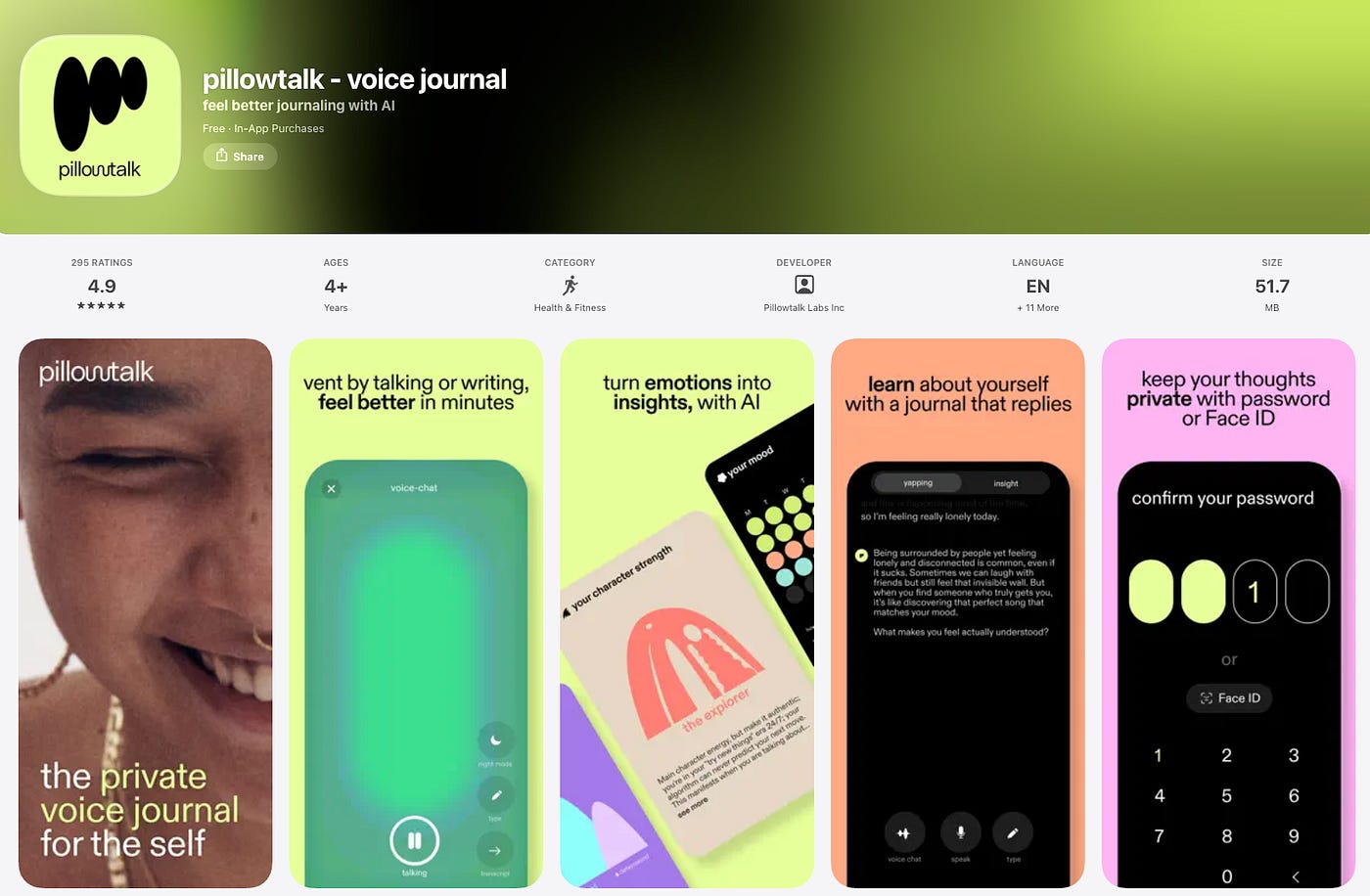
Pillowtalk was created by founders Belen and Cherri, born from co-founder Belen’s personal struggle with anxiety and sleep disorders. The app offers voice-to-text journaling with AI-powered insights, supporting transcription in over 99 languages. But here’s where it gets interesting: your journal entries stay locally stored on your device and are never used for AI training.
In an industry racing to harvest user data, this feels almost quaint. Almost naive. Until you look at the numbers.
The journal app market is expected to grow at a CAGR of 12.7% through 2033, and data privacy concerns are identified as a primary barrier to adoption. Google’s recent Pixel Journal launch with Gemini AI integration sparked immediate backlash, with privacy advocates arguing that AI-generated summaries and mood tracking defeat journaling’s core purpose of personal reflection.
Pillowtalk’s founders seem to understand something competitors are missing: your most vulnerable moments shouldn’t be used to train data.
The Product Anatomy: Simplicity as Strategy
From a product design perspective, Pillowtalk makes fascinating choices. The interface is deliberately minimal — no endless features, no gamification, no social feeds. Users describe it as conversational, with one noting it “wasn’t just insights or motivations; it felt like a friend giving me genuine advice”.
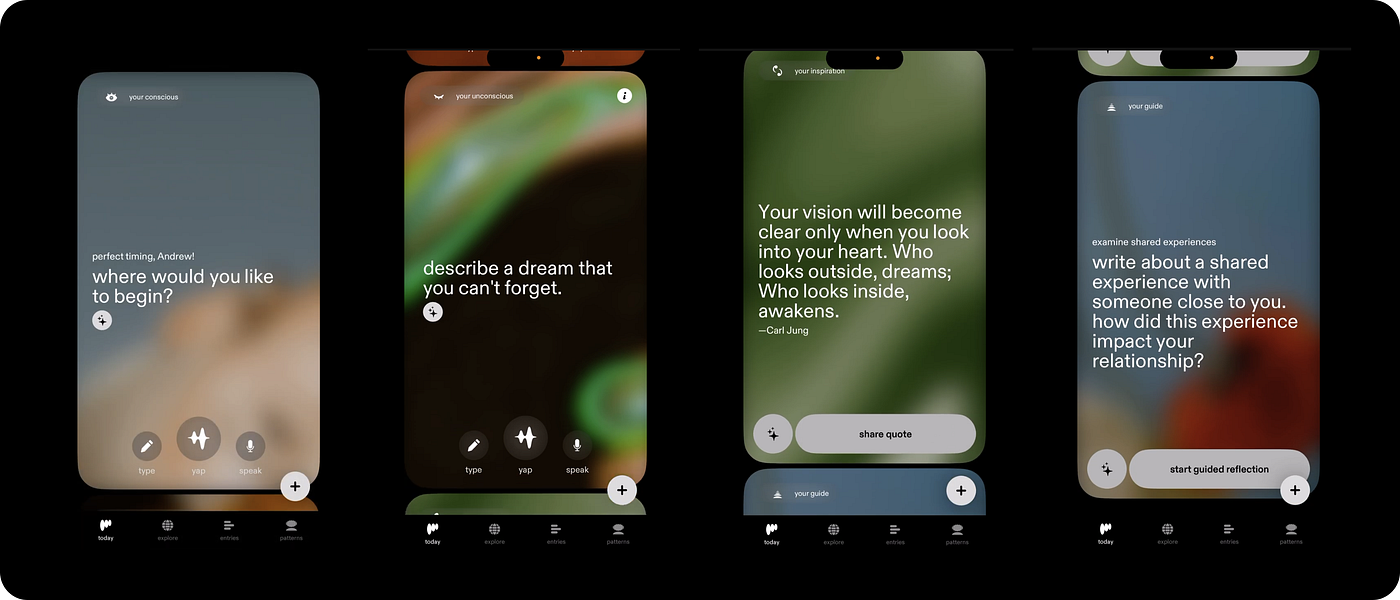
Minimalistic and elegant design language
The core loop is elegant:
Speak or type your thoughts (voice recognition removes friction)
Receive AI analysis that identifies patterns and provides insights
Optional guided prompts for deeper exploration
Dream journaling with AI interpretation
What’s missing is equally telling. No infinite scroll. No comparison metrics. No ads, no data selling, and password plus Face ID protection. The app earns through subscriptions for premium features like habit tracking and wellness content.
This restraint reveals mature product thinking. In a market where companies like Day One and Journey are enhancing user experience through AI-driven writing prompts and voice-to-text capabilities, Pillowtalk distinguishes itself not by doing more, but by protecting more.
The Trust Architecture
Here’s where product strategy meets behavioral psychology. Data breaches are a major concern with AI journaling tools due to security vulnerabilities, and platforms may use entries to train AI models or build user profiles. Even established companies like Bank of America experienced an incident in February 2024 that impacted 57,028 customers, highlighting why robust security is crucial.
Pillowtalk’s privacy architecture addresses this head-on:
All entries encrypted at rest (AES-256) and in transit (min TLS 1.2)
Local device storage as default
No access to Apple ID or Google ID financial information
Transparent privacy policy about data usage
But technical security is table stakes. The real innovation is psychological. Research shows privacy worries hold users back from analyzing large volumes of entries or sharing truly sensitive content. By removing the specter of surveillance, Pillowtalk creates space for genuine vulnerability.
One user captured this perfectly: “It’s a place where you can be as unfiltered and crazy as you want without burdening anyone while you vent your feelings”.
The Broader Pattern: AI’s Intimacy Problem
Pillowtalk’s approach illuminates a design principle that extends far beyond journaling. The industry is seeing revolutionary shifts toward AI-driven automation, but also enhanced cybersecurity and blockchain journaling for tamper-resistant documents. The market is bifurcating: tools that monetize your psychology versus tools that protect it.
Critics of Google’s Journal app quote Oliver Burkeman: “It isn’t really the thought that counts, but the effort, which is to say, the inconvenience”. When you make reflection too convenient, too algorithmic, you risk draining it of meaning. Pillowtalk threads this needle by using AI as a mirror, not a replacement, amplifying your voice rather than substituting it.
The app’s voice-first interface deserves special attention. One Portuguese-speaking user noted the voice feature helps phrase things better, with AI insights in English being very helpful. This reveals something crucial about inclusive design: removing the friction of translation (linguistic or emotional) can democratize self-reflection.
What Product Designers Can Learn
1. Privacy as Product Differentiation In crowded markets, extreme positions create clarity. Pillowtalk’s privacy stance isn’t a compromise — it’s a competitive moat. AI-powered features such as mood analysis and personalized prompts could greatly enhance user experience, but only when users trust the container.
2. Constraint Breeds Focus Pillowtalk describes itself as a private journal for unwinding, decluttering your mind, and finding balance. By resisting feature bloat, they’ve created something that actually works for its stated purpose. How many products can say that?
3. The Local-First Movement Locally stored entries that never touch AI training pipelines represent a broader architectural philosophy. As AI capabilities move to edge devices, products that keep sensitive data local gain strategic advantage.
4. Trust Through Transparency The app is free with optional subscription-based features and explicitly states it’s not a substitute for professional therapy. This boundary-setting builds credibility in a wellness market plagued by overpromising.
The Uncomfortable Questions
Of course, Pillowtalk isn’t perfect. The app is relatively new, and questions remain. How does the AI provide insights without accessing cloud computing at scale? When entries are “processed by AI to generate summaries and reflections,” where does that processing happen? The tension between local storage and AI analysis requires more scrutiny.
Some AI journaling apps provide responses that feel “canned” rather than genuinely insightful, and it’s unclear if Pillowtalk avoids this trap at scale. The danger of AI misinterpreting entries and providing misguided advice or focusing on irrelevant details remains real.
But these questions aren’t unique to Pillowtalk, they’re endemic to the entire AI wellness category. What sets this app apart is its willingness to acknowledge them.
Looking Forward: The Post-Surveillance Wellness Stack
As digital journaling with emphasis on mental wellness expands, with AI-generated mood logging and guided questions becoming mainstream, we’re heading toward a crucial fork in the road.
One path leads to ambient AI that analyzes device data including contacts, photos, location, and activities to suggest prompts, the surveillance capitalism model applied to self-reflection. The other path leads to tools like Pillowtalk that strengthen rather than exploit the user’s autonomy.
The market will reward both approaches in the short term. But studies show privacy concerns are a significant deterrent for consumers when using health-related applications. The question isn’t whether privacy-first design can work — it’s whether designers will choose it before regulation forces their hand.
The Bottom Line
Pillowtalk won’t be the last word in AI journaling. It’s too early, too niche, too principled to dominate a market this size. But it represents something important: proof that you can build AI products that enhance rather than extract, that empower rather than exploit.
As one product designer using the app noted: “I found talking through my thoughts on Pillowtalk very helpful. I get to deep dive into an idea, and it leaves me feeling great afterward”. That simple testimonial captures what great products should aspire to — not just utility, but a feeling of growth.
In a world drowning in surveillance technology marketed as wellness, Pillowtalk’s greatest achievement might be reminding us that the most powerful AI interfaces are the ones that know when to forget.
For product designers and founders: What does it mean to build truly user-centric AI when the easiest business model is data extraction? How do we design for vulnerability without exploiting it? These aren’t just technical questions — they’re ethical ones that will define our industry’s next decade.
Your thoughts are your own. The question is: do your tools remember that?
References
Market Research Future. (2024). “Digital Journal Apps Market Size, Growth Drivers 2034.” https://www.marketresearchfuture.com/reports/digital-journal-apps-market-29194
Data Horizzon Research. (2024). “Journal App Market Size, Growth, Share, & Analysis Report — 2033.” https://datahorizzonresearch.com/journal-app-market-40790
Apple App Store. (2025). “pillowtalk — voice journal.” https://apps.apple.com/us/app/pillowtalk-voice-journal/id6484401671
Pillowtalk Labs. (2024). “pillowtalk | your space to grow, reflect, and connect.”
https://talkpillowtalk.com/
MakeUseOf. (2024). “AI Journaling Tools Are Great — Until You Realize the Risks.” https://www.makeuseof.com/ai-journaling-tools-privacy-risks/
Pausa Blog. (2024). “Common Privacy Issues in AI Journaling.” https://www.pausa.co/blog/common-privacy-issues-in-ai-journaling
Psyche. (2025). “What I learned from sharing my private self with an AI journal.” https://psyche.co/ideas/what-i-learned-from-sharing-my-private-self-with-an-ai-journal
TechBuzz AI. (2024). “Google Journal AI Features Spark Privacy Backlash.” https://www.techbuzz.ai/articles/google-journal-ai-features-spark-privacy-backlash
Business Research Insights. (2024). “Journal App Market Growth, Trends Analysis Report by 2033.” https://www.businessresearchinsights.com/market-reports/journal-app-market-120441
Future Market Insights. (2025). “Digital Journal Apps Market Size, Demand & Trends 2025–2035.” https://www.futuremarketinsights.com/reports/digital-journal-apps-market