

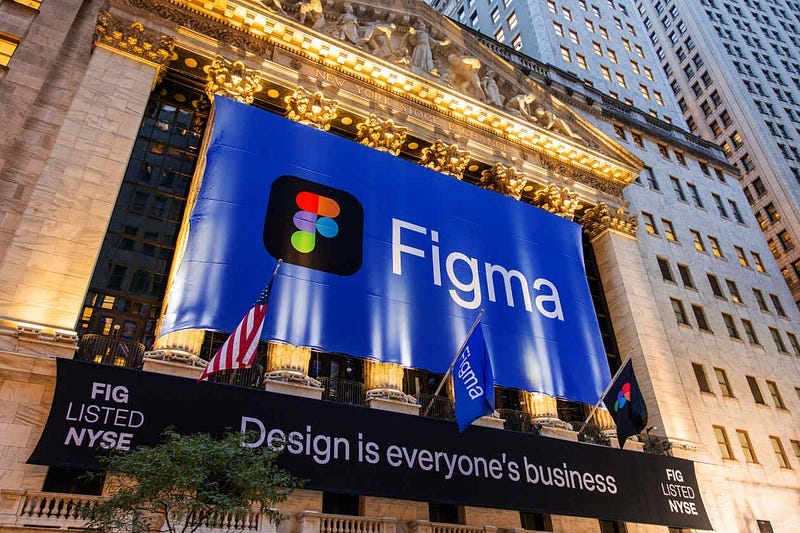
On April 17, I watched a stock chart do something I’d never seen a design tool trigger before.
Anthropic launched Claude Design — a tool that turns a sentence into a working prototype — and Figma’s stock dropped seven percent the same day. Adobe slid. Wix and GoDaddy caught the downdraft too. Three days earlier, Anthropic’s chief product officer had quietly stepped off Figma’s board. The narrative wrote itself in about ninety minutes: the canvas is dead, the design tool is a commodity, just describe what you want and skip the pixels entirely.
I believed a softer version of it myself. I’d spent the previous month building a small app to help founding designers find suitable design systems for their product, bouncing between tools to see which one could take me from idea to shipped thing fastest. The gap between “I have a thought” and “I have a working screen” had collapsed so completely that the death-of-Figma story felt less like a hot take and more like a description of my Tuesday.
Then May happened, and the story fell apart in the most instructive way possible.
The plot twist nobody priced in
On May 15, Figma reported its Q1 numbers. Revenue was $333.4 million, up 46% year over year. Net dollar retention hit 139% — its highest in over two years. The company raised its full-year outlook. This is not what a disrupted business looks like. This is what a business looks like when the thing everyone thought would kill it turns out to be aimed at a slightly different target.
Five days later, on May 20, Figma shipped its own native AI design agent — one that lives directly on the canvas, reads your existing components and tokens, and edits your actual files instead of generating throwaway screens in a separate tab. You can even run several agents in parallel on the same multiplayer canvas.
So here’s the arc, start to finish, in about five weeks: a prompt-to-product tool launches, the market panics, the “disrupted” company posts a record quarter and then absorbs the disruptor’s core capability into its own surface. If you only read the April headlines, you got the story exactly backwards.
What the panic got wrong
The mistake was treating generation and coordination as the same problem.
Generating a screen is now nearly free. Claude Design, Google Stitch, Figma Weave, Canva’s AI 2.0 — every adjacent layer can now turn a prompt into something polished in seconds. That capability genuinely commoditized, fast, and the panic correctly sensed it.
But generating a screen was never the hard part of product work. The hard part is the part that happens around the screen: deciding which screen is worth building, keeping thirty people aligned on why, threading it through a design system, governing what ships, and holding the institutional memory of every decision that got you here. As one analyst put it after Figma’s earnings, generating an interface is getting cheaper everywhere — but coordinating what happens to that interface across a team of thirty people is still Figma’s problem to own.
That’s why Figma’s numbers went up during the exact window it was supposedly being killed. The generation layer got cheaper. The coordination layer — the multiplayer canvas, the shared system, the place 690,000 paying teams already live — got more valuable, because more raw output flowing through an organization means more need for somewhere to organize it.
The signal underneath the signal
There’s a quieter data point I can’t stop thinking about. A recent survey of 900 designers found that weekly AI usage for design tasks jumped from 54% to 91% in a single year, and that half of those surveyed — product and brand designers, not just engineers — have shipped AI-generated code to production. Even managers are shipping it, sometimes more than their individual contributors.
Read alongside the Figma story, that survey says something specific: AI didn’t replace the designer’s output, it relocated the designer’s attention. When generation is free, the scarce resource becomes judgment — knowing what’s worth generating, recognizing when the polished thing is wrong, and owning the decision to ship. The tools raced down to the canvas. The value floated up toward direction.
What I’m actually doing differently
A few takeaways I’d hand to anyone designing or building product right now:
Treat generation as a draft, not a deliverable. The first polished output is the cheapest part of the process and the easiest to fall in love with. The skill that’s appreciating is editing — knowing what to cut from something that already looks finished.
Invest in the layer that gets more valuable as output gets cheaper. For teams, that’s the system, the governance, the shared source of truth. For individuals, it’s taste and proximity to the real customer problem. Whatever survives commoditization is where to put your hours.
Stop asking which tool wins. Ask which layer you’re competing on. Claude Design and Figma weren’t actually fighting over the same thing — one optimized generation, the other coordination. Most “X kills Y” framings in AI are a category error in disguise.
Watch what companies do under pressure, not what markets do on launch day. The seven-percent drop was a vibe. The record quarter and the canvas agent were the answer.
The open question
Figma’s response to commoditized generation was to make generation native and keep owning coordination. It worked — this quarter. But the deeper question stays open: as AI gets better at the coordination layer too — at remembering decisions, aligning teams, governing what ships — does the durable moat move again?
My bet is that it keeps floating upward, toward the things that are hardest to specify in a prompt: knowing which problem deserves a product at all, and having the taste to recognize when the answer the machine handed you is confidently, beautifully wrong.
The month Figma was supposed to die turned out to be the month it proved where the value actually lives. The next disruption headline you read is worth running through the same test: is this tool competing on generation, or on judgment? Because only one of those is getting cheaper.
References
VentureBeat — Anthropic just launched Claude Design, an AI tool that turns prompts into prototypes and challenges Figma (April 17, 2026): https://venturebeat.com/technology/anthropic-just-launched-claude-design-an-ai-tool-that-turns-prompts-into-prototypes-and-challenges-figma
DesignRush — Anthropic Launches Claude Design AI Tool: https://news.designrush.com/anthropic-claude-design-launch-figma
PYMNTS — After Claude Design Launched, Figma Raised Its Full-Year Outlook (May 15, 2026): https://www.pymnts.com/artificial-intelligence-2/2026/after-claude-design-launched-figma-raised-its-full-year-outlook/
The Next Web — Figma builds its own AI assistant that can design alongside you on the canvas: https://thenextweb.com/news/figma-builds-its-own-ai-assistant-that-can-design-alongside-you-on-the-canvas
Gadgetbond — Figma rolls out a native AI design agent that edits in your file (May 20, 2026): https://gadgetbond.com/figma-ai-design-agent-launch/
Figma Learn — Release notes roundup: May 2026: https://help.figma.com/hc/en-us/articles/40219873508247-Release-notes-roundup-May-2026
Designer Fund & Foundation Capital — AI in Design 2026: https://designerfund.com/blog/ai-in-design-2026
The AI Insider — Figma Launches Native AI Design Agent as Revenue Surges 46%: https://theaiinsider.tech/2026/05/21/figma-launches-native-ai-design-agent-as-revenue-surges-46-amid-intensifying-competition/