

The moment the demo becomes real life
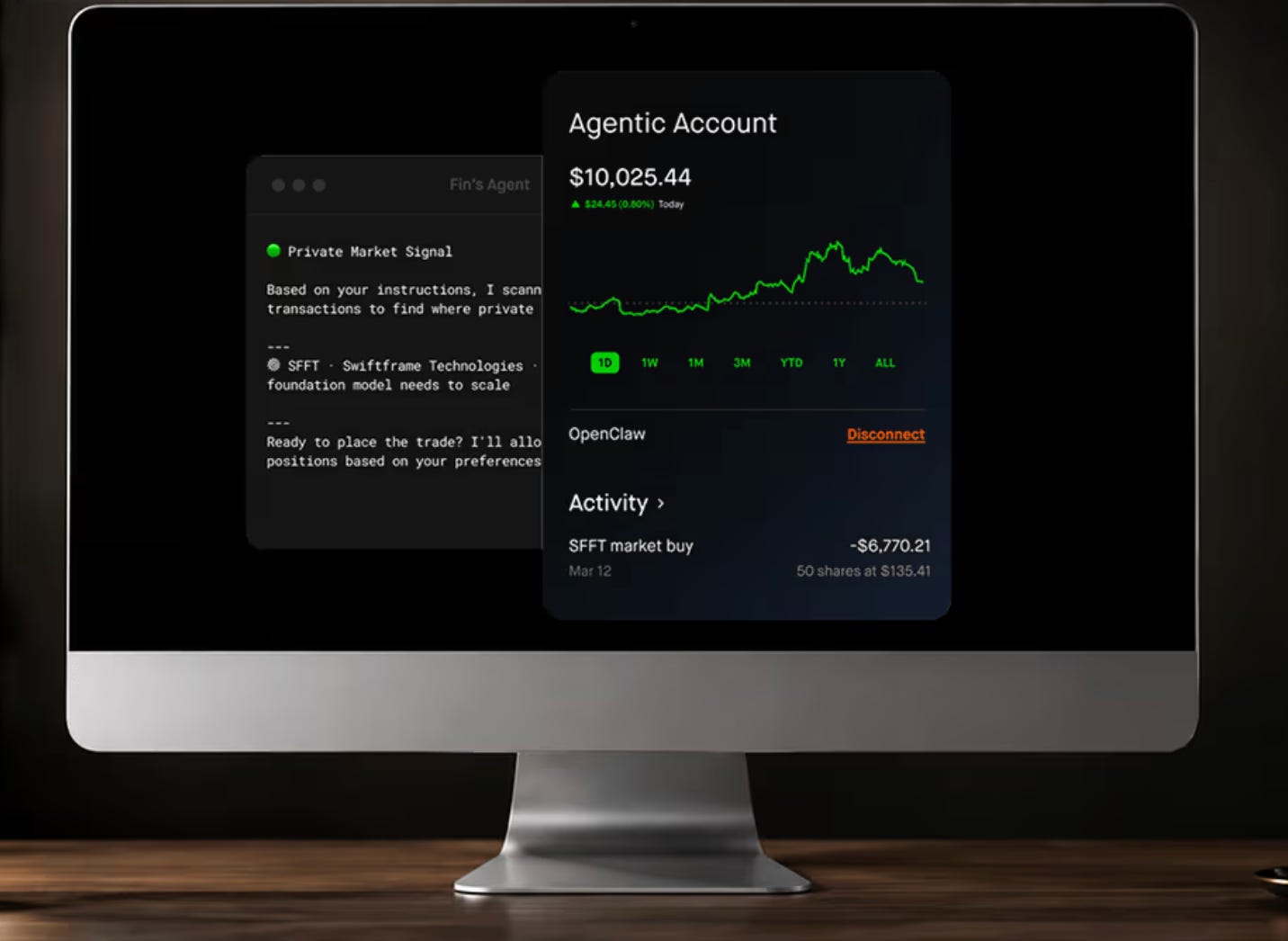
A few weeks ago, I was talking to a friend who works in fintech about AI agents. The conversation stayed abstract — tools calling tools, autonomous workflows, “the agent economy.” Then she pulled out her phone and showed me Robinhood’s new agentic trading feature, which had gone live on May 27th. She’d already funded a dedicated account, connected it to a third-party AI agent via MCP, and given it a standing instruction: rebalance toward AI supply chain stocks whenever my exposure drops below 20%.
The agent had already made three trades. While we were having coffee.
That’s the moment the abstract becomes visceral. And for those of us who design digital products for a living, it raises a question that goes way beyond fintech: what does it actually mean to design for a user who isn’t always the one clicking?
What Robinhood Actually Launched
On May 27, 2026, Robinhood unveiled two products that collectively represent one of the most consequential UX bets in recent memory: Agentic Trading and an Agentic Credit Card.
The trading feature lets users create a dedicated, ring-fenced account that a third-party AI agent can access via Robinhood’s Model Context Protocol (MCP) server. The agent can analyze portfolios, monitor concentration risk and sector exposure, scan analyst notes for new opportunities, backtest strategies, and — crucially — execute trades. All without the user touching anything. A real-time activity feed and push notifications surface every trade after the fact, and users can disconnect the agent with a single tap.
The credit card side works similarly. Gold Card holders can issue a virtual card to their AI agent, set monthly spending caps, toggle manual approval mode on or off, and let the agent buy things — flights when prices dip, sneaker drops the moment they hit a threshold — autonomously.
CEO Vlad Tenev framed it around Robinhood’s founding thesis: “Our mission has always been to democratize finance for all, and now, that mission extends to AI agents.” The implication being that hedge funds have run algorithmic trading for decades. Now retail investors get the same infrastructure. That’s a genuinely compelling democratization story — and also a genuinely complicated design problem.
The Broader Shift This Belongs To
Robinhood’s launch didn’t happen in isolation. It’s one node in a rapidly forming ecosystem where financial action is being decoupled from human decision-making at the moment of execution.
Stripe has been building what it calls the “Agentic Commerce Suite” — infrastructure that lets AI agents discover products, negotiate purchases, and complete transactions on behalf of users through a single integration. Amazon, in partnership with Coinbase and Stripe, launched Bedrock AgentCore Payments in May, enabling agents to autonomously pay for APIs, data feeds, and digital services at the infrastructure level. Stripe’s own Machine Payments Protocol (MPP), launched in developer preview in March 2026, provides AI agents with cryptographic identity and programmable spending controls for sub-second, autonomous settlement.
The direction is unmistakable. The question of whether agents will transact is settled. The open design question is how do we make that safe, legible, and trustworthy for real people?
Why This Is a Design Problem, Not Just a Tech Problem
Here’s what struck me most about Robinhood’s product launch: the safety architecture is genuinely thoughtful — isolated accounts, spending caps, kill switches, manual approval toggles, real-time notifications — but the liability language in the disclosures is almost disarmingly honest. Robinhood explicitly states it “does not guarantee the accuracy, completeness, or suitability of any agent output” and is “not responsible for losses resulting from agent-generated decisions.” Users are responsible for monitoring positions and ensuring the agent is operating as intended.
That’s not a dodge. That’s a design constraint hiding in legal text.
Because here’s the thing: when a user sets up an agentic trading account, they’re not just granting access. They’re delegating judgment. And delegating judgment to software — especially software that can move real money without asking first — requires a level of trust that our current UX vocabulary was never built to handle.
We’ve spent fifteen years designing for what I’d call the “click-confirm loop”: user intends action → user sees affordance → user confirms → system executes. Every major safety pattern in finance and e-commerce has been built around that loop. Two-factor auth, order previews, “are you sure?” dialogs, purchase confirmations. All of it assumes a human at the moment of execution.
Agentic products break that loop by design. The human is present at the instruction stage and the review stage — but not at the execution stage. That’s a fundamentally different trust relationship, and it requires different design primitives.
What the Design Playbook Might Look Like
I’ve been thinking about this in terms of three new patterns that product designers will need to develop:
1. Intent Legibility When a user sets an instruction for an agent — “buy any AI infrastructure stock that drops more than 3% in a day” — they need to understand, in advance, what edge cases that instruction might hit. This is the design equivalent of writing a legal contract. The interface needs to surface ambiguity before the agent acts on it, not after. Robinhood’s examples (rebalancing portfolios, building thematic positions, backtesting strategies) are evocative but underspecified for a user who’s never thought about what “mean reversion” actually implies in a volatile week.
2. Ambient Accountability The real-time activity feed is the right instinct. But it’s a notification-based model — it tells you what happened. The next design frontier is anticipatory transparency: showing a user what the agent is about to do before it does it, with just enough friction to prompt a moment of human judgment without breaking the automation promise. Robinhood’s “trade preview” feature goes partway there. The interface challenge is making that preview feel like genuine oversight rather than an interruption.
3. Graceful Failure Surfaces When an AI agent makes an error — misinterprets an instruction, acts on stale data, executes a trade the user didn’t mean to authorize — the recovery experience matters as much as the prevention experience. Designing for agent failure is still largely terra incognita. What does an “undo” look like when real money has already moved? What does the dispute flow look like when the user technically authorized the agent but didn’t anticipate the outcome?
The Deeper Shift
What Robinhood’s launch really signals is that we’re entering an era where the user and the actor are no longer the same entity. The user sets policy. The agent executes it. The product designer’s job is to make that delegation legible, reversible, and trustworthy — without making it so friction-laden that the whole value proposition collapses.
This is harder than it sounds. The instinct will be to add confirmations, approvals, and “are you sure?” moments until the agent feels safe. But an agent you have to approve on every action isn’t an agent — it’s a slower version of doing it yourself. The real design challenge is building enough oversight to maintain user trust without undermining the autonomy that makes agents useful in the first place.
Stripe’s Head of Information and Data Science Emily Glassberg Sands put it well: “Agents don’t just change who’s at the checkout. They change who’s doing the searching, the deciding, the trusting — all of it.”
That’s the shift worth sitting with. The parts of product design that used to be UX problems are becoming protocol problems. And the parts that are still UX problems — trust, legibility, accountability — are becoming the hardest design problems in the industry.
A Question Worth Wrestling With
I keep coming back to this: Robinhood’s feature is explicitly targeted at “early adopters of agents” who want to “bring their own tools.” That’s a technically sophisticated, high-intent user. But the long-term vision is clearly mass-market — the same democratization story Robinhood has always told, now extended to autonomous finance.
When agentic trading reaches mainstream retail investors — people who don’t know what MCP stands for, who set up an instruction once and forget about it — what does the design responsibility look like then?
That’s the question I’d love to hear your take on. Because I don’t think anyone has a clean answer yet.
References
Mehta, I. (2026, May 27). Robinhood now lets your AI agents trade stocks. TechCrunch. https://techcrunch.com/2026/05/27/robinhood-now-lets-your-ai-agents-trade-stocks/
CNBC. (2026, May 27). Your AI agent can now trade for you on Robinhood. https://www.cnbc.com/2026/05/27/your-ai-agent-can-now-trade-for-you-on-robinhood-and-buy-stuff-with-your-credit-card-too.html
Robinhood Newsroom. (2026, May 27). Robinhood is now open to agents. https://robinhood.com/us/en/newsroom/robinhood-is-now-open-to-agents/
Robinhood. (2026). Agentic Trading overview. https://robinhood.com/us/en/support/articles/agentic-trading-overview/
Fortune. (2026, May 27). Robinhood launches credit card for AI agents with 3% cash back. https://fortune.com/2026/05/27/robinhood-ai-agents/
AWS Machine Learning Blog. (2026, May 7). Agents that transact: Introducing Amazon Bedrock AgentCore payments. https://aws.amazon.com/blogs/machine-learning/agents-that-transact-introducing-amazon-bedrock-agentcore-payments-built-with-coinbase-and-stripe/
Stripe. (2026). Introducing the Agentic Commerce Suite. https://stripe.com/blog/agentic-commerce-suite
Glassberg Sands, E. (2026). Quoted in Stripe’s Guide to Agentic Commerce. https://stripe.com/guides/agentic-commerce
Forrester. (2026, May). Stripe Sessions 2026: Stripe is rearchitecting payments for an agentic AI economy. https://www.forrester.com/blogs/stripe-sessions-2026-stripe-is-rearchitecting-payments-for-an-agentic-ai-economy/
Memeburn. (2026). Robinhood Agentic Trading: AI now buys stocks for you. https://memeburn.com/robinhood-now-lets-ai-agents-trade-stocks-and-shop-for-you-in-2026/